


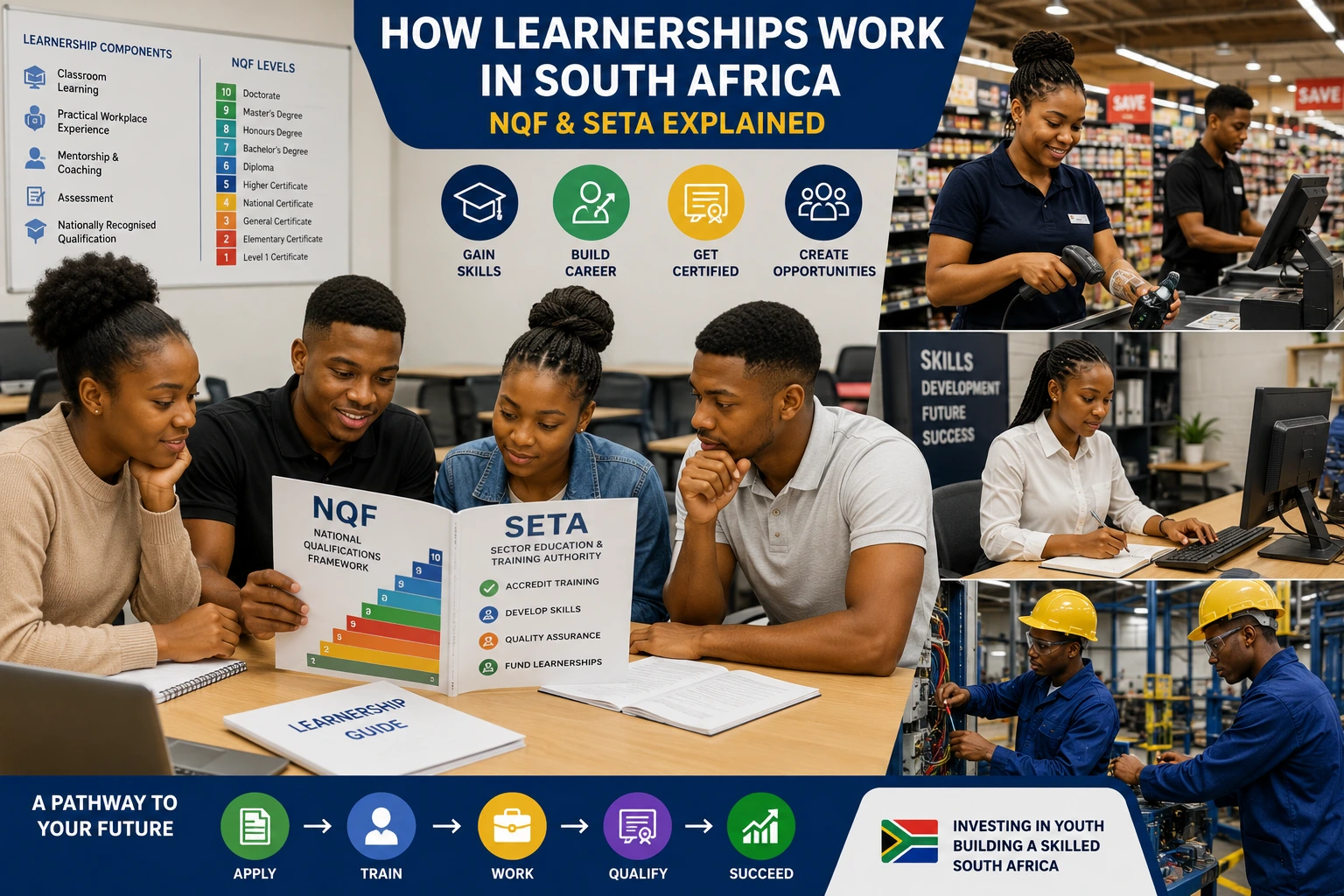
Learn how learnerships work in South Africa, including NQF levels, SETA funding, stipends, qualifications, and why learnerships remain important for youth employment in 2026.
How Learnerships Work in South Africa: NQF and SETA Explained
South Africa’s learnership system has become one of the country’s most important tools for addressing youth unemployment, workplace skills shortages, and practical training gaps. Yet despite thousands of young people applying for learnership opportunities every year, many applicants still do not fully understand how the system actually works.
Terms such as NQF Level, SETA accreditation, and SAQA registration frequently appear in job adverts, but they are often misunderstood or ignored during applications. For many job seekers, learnerships simply appear to be temporary jobs with monthly stipends. In reality, they form part of a structured national skills development framework designed to connect education with real workplace experience.
As South Africa continues to face high unemployment rates among young people, learnerships remain one of the few programmes combining theoretical learning with practical work exposure. Companies across industries — including retail, telecommunications, banking, logistics, mining, and administration — increasingly rely on learnerships to develop future employees while also meeting national training requirements.
Understanding how the system works can help applicants avoid common mistakes, improve eligibility, and make better long-term career decisions.
ALSO READ 9 Proven Ways to Turn Your Internship Into a Permanent Job in South Africa (2026 Career Guide)
ALSO APPLY FOR PepsiCo R&D WIL Learnership 2026 Opens in Isando: 5 Critical Reasons Food Science Students Should Apply Immediately
What Is a Learnership in South Africa?
A learnership is a structured training programme that combines: How Learnerships Work in South Africa
- Classroom-based theoretical learning
- Practical workplace experience
Unlike traditional short courses, learnerships are linked to nationally recognized qualifications registered on South Africa’s National Qualifications Framework (NQF).
This means that successful learners receive formal credits toward recognized occupational qualifications.
Most learnerships are designed for: How Learnerships Work in South Africa
- Unemployed youth
- Matriculants
- TVET students
- Entry-level workers
- Individuals seeking workplace experience
However, some programmes also target employed staff members who need additional industry qualifications.
One important difference between a learnership and a normal internship is that learnerships usually include both formal assessment and accredited training standards.
This is why employers often request:
- SAQA-aligned qualifications
- SETA certification
- NQF-level requirements
These systems work together within South Africa’s national skills development structure.
Understanding the NQF System in South Africa || How Learnerships Work in South Africa
The focus keyword — How Learnerships Work in South Africa — cannot be properly explained without understanding the National Qualifications Framework (NQF).
The NQF is South Africa’s standardized system for organizing educational and occupational qualifications.
It was developed to ensure that qualifications across schools, colleges, universities, and workplace training programmes follow consistent national standards.
The framework ranges from NQF Level 1 to NQF Level 10.
Here is a simplified breakdown: How Learnerships Work in South Africa
| NQF Level | Qualification Type |
|---|---|
| Level 1 | Grade 9 |
| Level 2 | Grade 10 |
| Level 3 | Grade 11 |
| Level 4 | Matric / National Senior Certificate |
| Level 5 | Higher Certificates |
| Level 6 | Diplomas / Advanced Certificates |
| Level 7 | Bachelor’s Degrees |
| Level 8 | Honours Degrees |
| Level 9 | Master’s Degrees |
| Level 10 | Doctorates |
Most learnerships for unemployed youth fall between NQF Level 2 and Level 5.
For example: How Learnerships Work in South Africa
- Retail learnerships often operate at NQF Level 2 or 3
- Business administration programmes commonly sit at NQF Level 4
- Technical telecom or IT learnerships may reach NQF Level 4 or 5
The NQF system helps employers understand the complexity and educational level of a programme.
It also helps learners build qualifications progressively over time.
What Is a SETA and Why Does It Matter?
One of the most confusing parts of the South African learnership system is the role of SETAs.
SETA stands for: How Learnerships Work in South Africa
Sector Education and Training Authority
SETAs were created to manage skills development within specific industries.
Each SETA focuses on a particular economic sector.
Examples include:
- Retail and Wholesale SETA
- BANKSETA
- MICT SETA (Media, Information and Communication Technologies)
- Services SETA
- Transport SETA
- Construction SETA
Their responsibilities include:
- Accrediting learnership programmes
- Monitoring training quality
- Managing skills funding
- Supporting workplace development
- Issuing certification
When a learnership advert mentions that applicants must provide a SETA certificate, it usually means the programme was formally funded and accredited through a registered SETA process.
This matters because employers need proof that applicants completed recognized training rather than informal attendance programmes.
How Learnership Funding Works-How Learnerships Work in South Africa
One reason learnerships remain popular is that learners usually receive monthly stipends.
However, many applicants misunderstand where this funding comes from.
In most cases, companies offering learnerships receive financial support or incentives connected to national skills development initiatives.
Funding can involve: How Learnerships Work in South Africa
- SETA grants
- Skills development levies
- Government training incentives
- Employer training budgets
Businesses benefit because learnerships help them:
- Develop future talent pipelines
- Improve workforce skills
- Meet transformation goals
- Access tax incentives in some cases
Learners benefit because they gain:
- Workplace exposure
- Practical training
- Nationally recognized qualifications
- Monthly financial support
The stipend itself is not considered a full salary. Instead, it functions as training support intended to help learners cover transportation, meals, and basic participation costs.
Amounts vary significantly depending on the industry and employer.
Why Employers Value Learnership Experience-How Learnerships Work in South Africa

In recent years, employers have increasingly valued candidates with learnership exposure.
This is largely because learnerships introduce participants to:
- Workplace discipline
- Communication standards
- Operational systems
- Team collaboration
- Industry-specific procedures
Many South African employers now prioritize practical adaptability over theoretical knowledge alone.
A candidate with workplace exposure through a learnership may often perform better operationally than someone with qualifications but no practical experience.
This is especially true in industries such as:
- Retail
- Telecommunications
- Logistics
- Customer service
- Administration
- Technical operations
Learnerships also help young people develop confidence within professional environments.
For first-time workers, this transition can be extremely important.
Common Mistakes Applicants Make-How Learnerships Work in South Africa
Despite the popularity of learnerships, many applicants lose opportunities because they misunderstand the process.
Some common mistakes include: How Learnerships Work in South Africa
Applying Without Certified Documents-How Learnerships Work in South Africa
Most learnerships require: How Learnerships Work in South Africa
- Certified ID copies
- Certified Matric certificates
- Updated CVs
- Proof of qualifications
Failure to provide these correctly can result in automatic disqualification.
Ignoring NQF Requirements
Applicants often apply for programmes above or below their qualification level without understanding the NQF structure.
Losing SETA Certificates
Many employers now require official SETA-issued certificates for previously completed learnerships.
Statements of results or attendance letters are often rejected.
Assuming Learnerships Guarantee Permanent Jobs
A learnership improves employability but does not automatically guarantee permanent employment.
However, strong performance during training may increase future opportunities.
Why Learnerships Remain Important in 2026
South Africa’s employment market remains highly competitive, particularly for young people without workplace exposure.
At the same time, companies continue facing operational skills shortages across multiple industries.
Learnerships help bridge that gap by combining:
- Skills development
- Workplace readiness
- Industry exposure
- Accredited qualifications
As industries become more technology-driven, employers increasingly require workers capable of adapting to structured operational environments.
This means learnerships may continue growing in importance over the next several years.
Fields currently showing strong learnership demand include:
- ICT and telecommunications
- Retail operations
- Financial services
- Renewable energy
- Logistics and supply chain
- Technical trades
For many young South Africans, learnerships remain one of the most accessible ways to gain credible workplace experience while building nationally recognized qualifications.
What This Means Going Forward-How Learnerships Work in South Africa
The South African learnership system is gradually evolving from a simple youth employment intervention into a more strategic workforce development model.
Employers increasingly use learnerships to identify adaptable, trainable candidates who can support long-term operational growth.
This shift may lead to:
- Higher qualification standards
- More specialized technical programmes
- Greater emphasis on workplace discipline
- Increased demand for practical skills
- Stronger alignment between training and industry needs
For job seekers, understanding concepts like NQF levels, SETA accreditation, and SAQA recognition is becoming increasingly important.
Applicants who understand how the system works are often better positioned to:
- Apply for suitable opportunities
- Prepare proper documentation
- Avoid disqualification
- Build long-term career pathways
In a competitive employment environment, knowledge of the learnership system itself can become an advantage.
FAQs-How Learnerships Work in South Africa
What is the difference between a learnership and an internship?
A learnership includes both workplace training and a nationally recognized qualification linked to the NQF system. Internships mainly focus on workplace experience and may not always include accredited qualifications.
Do all learnerships pay stipends?
Most South African learnerships offer monthly stipends, but the amount varies depending on the employer, industry, and funding structure.
Conclusion-How Learnerships Work in South Africa
Learnerships remain one of South Africa’s most important skills development tools because they combine practical experience with accredited training. Understanding the roles of NQF levels, SETAs, and SAQA accreditation helps applicants make more informed decisions when applying for opportunities.
As industries continue demanding workplace-ready employees, learnerships are likely to remain valuable pathways into employment, technical training, and long-term career development.
For young South Africans navigating a competitive job market, understanding how learnerships work may be just as important as securing the opportunity itself.





Leave a Reply