


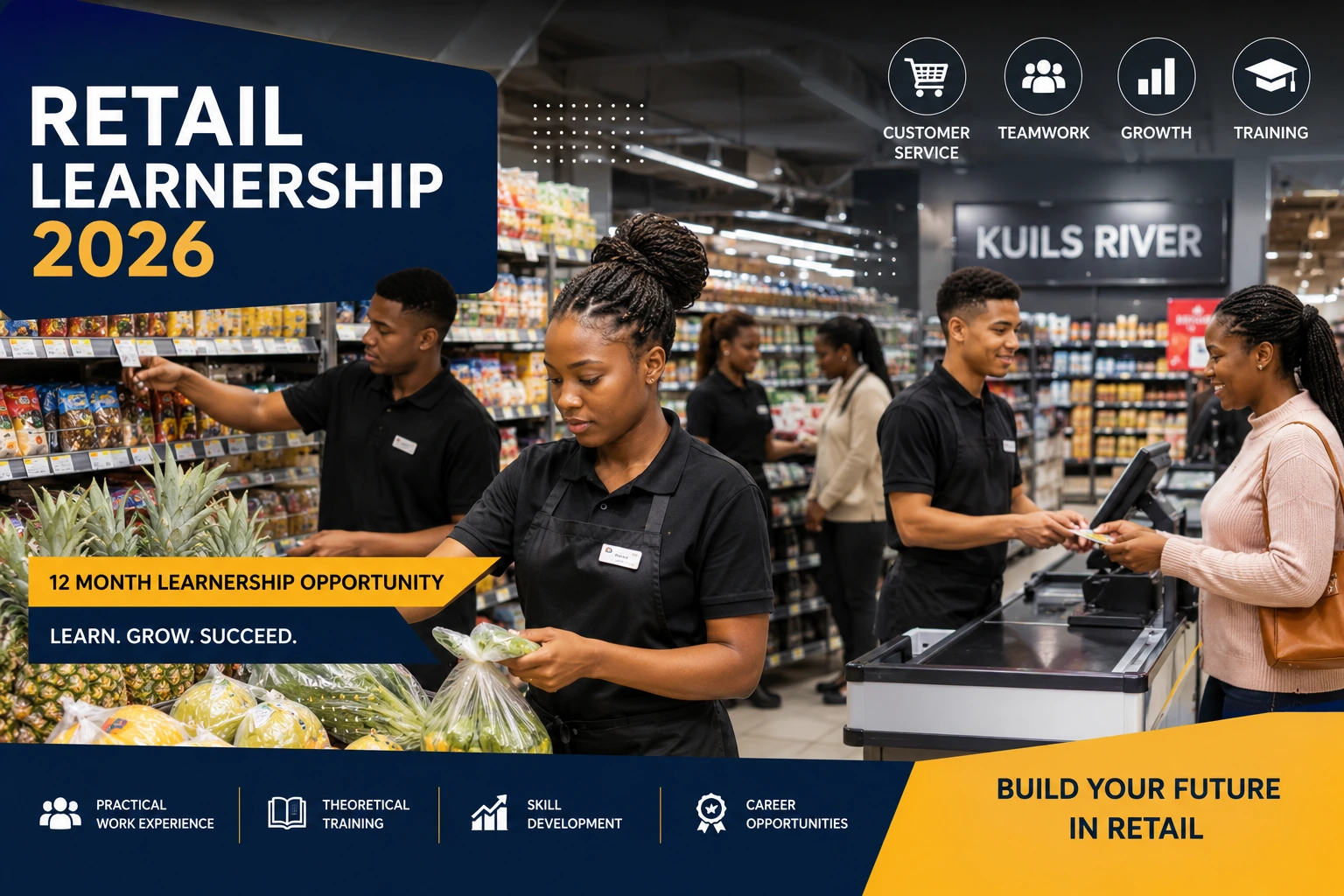
Explore the 12 Month Retail Learnership 2026 in Kuils River, including requirements, retail experience expectations, stipend details, and what this opportunity reveals about South Africa’s changing retail job market.
Retail Learnership 2026 in Kuils River: Why Employers Are Looking Beyond Entry-Level Applicants
South Africa’s retail industry continues to evolve under growing economic pressure, changing customer expectations, and increased competition among retailers. While learnership programmes have traditionally targeted first-time job seekers with little or no experience, a noticeable shift is emerging in 2026.
More employers are now looking for candidates who already possess workplace exposure, especially within customer-facing retail environments.
The newly advertised 12 Month Learnership opportunity in Kuils River reflects that shift clearly. Instead of focusing solely on unemployed youth without experience, this programme specifically requires applicants to have between 2 to 3 years of retail experience, alongside supervisory exposure.
That requirement signals an important development in South Africa’s employment landscape: companies are increasingly using learnerships not only as entry pathways, but also as workforce development tools aimed at improving operational efficiency in fast-moving retail environments.
For many young South Africans seeking career stability, this learnership may represent more than temporary employment. It offers insight into how retail employers are redefining practical workplace readiness in a challenging economic climate.
ALSO APPLY FOR Ericsson Telecommunication Network Operations Learnership 2026: Why This Opportunity Could Shape South Africa’s Digital Workforce
Quick Facts Box-Retail Learnership 2026
| Category | Details |
|---|---|
| Programme Name | 12 Month Learnership Programme |
| Company | Not stated in the official advert |
| Location | Kuils River, Western Cape |
| Duration | 12 Months |
| Closing Date | 11 May 2026 |
| Positions Available | Not stated in the official advert |
| Reference Number | Not stated in the official advert |
| Stipend | Monthly stipend offered |
| Required Gender | Not stated in the official advert |
Understanding Why Retail Learnerships Are Changing-Retail Learnership 2026
For years, retail learnerships were often designed around basic customer service and entry-level operational tasks. Applicants with only Grade 12 qualifications could often secure opportunities without previous workplace experience.
However, the retail sector of 2026 is operating under very different conditions.
Retailers today face pressure from:
- Rising operational costs
- Increasing customer service expectations
- Inventory management challenges
- Digital shopping competition
- Economic uncertainty affecting consumer spending
As a result, businesses are becoming more selective about the type of candidates they recruit — even within learnership programmes.
This Kuils River learnership reflects that broader trend by prioritizing candidates who already understand:
- Retail floor operations
- Customer interaction
- Team coordination
- Workplace discipline
- Supervisory responsibilities
Rather than training individuals entirely from scratch, the programme appears structured to refine and strengthen existing retail capabilities.
That shift may improve productivity for employers while also giving experienced youth workers an opportunity to formalize their skills through structured learning.
Why Previous Retail Experience Matters More Than Ever-Retail Learnership 2026
One of the most significant requirements in this learnership is the expectation that applicants already possess 2 to 3 years of retail experience.
This is notable because it changes the traditional perception of learnership programmes as purely beginner-level opportunities.
The retail sector increasingly values practical adaptability over theoretical knowledge alone. Employees working in fast-paced environments must often manage:
- Customer complaints
- Stock movement
- Point-of-sale systems
- Shift coordination
- Team communication
- Sales targets
Candidates with previous exposure are generally able to transition into operational roles more quickly.
The requirement for supervisory experience further suggests that employers are searching for individuals capable of handling responsibility within team-based retail environments.
This could indicate that the programme is intended to support future junior leadership pipelines rather than only basic entry-level staffing.
For applicants, this means that prior workplace exposure may now carry significantly more weight than simply holding a qualification.
The Importance of Location-Based Recruitment || Retail Learnership 2026
Another important feature of this learnership is its strong focus on community-based recruitment.
Applicants must reside within or near:
- Wembley Park
- Highbury
- Camelot
- Hagley
- Riverside
- Kalkfontein
- Gersham
- Wesbank
- Mfuleni
This geographic targeting is increasingly common within South African retail recruitment strategies.
There are several possible reasons for this approach: Retail Learnership 2026
1. Reduced Transportation Challenges-Retail Learnership 2026
Retail work often involves shift schedules, weekend hours, and extended operational times. Recruiting locally helps reduce attendance problems linked to transport costs and commuting difficulties.
2. Workforce Stability-Retail Learnership 2026
Employees living closer to workplaces are often easier to retain over longer periods.
3. Community Employment Development-Retail Learnership 2026
Companies are under growing pressure to support local economic participation and youth employment within surrounding communities.
The emphasis on proximity also highlights how practical logistics continue to shape employment opportunities in South Africa’s urban retail sector.
Why SETA Compliance Has Become a Major Requirement-Retail Learnership 2026
The advert places unusual emphasis on SETA-issued certificates for candidates who previously completed funded learnerships.
It specifically notes that:
- Statements of results will not be accepted
- Attendance certificates are insufficient
- Official SETA certification is required
This reflects a broader compliance trend within South Africa’s skills development system.
Employers increasingly need accurate documentation to verify:
- Previous funded programme participation
- Qualification authenticity
- Skills development eligibility
- Learnership funding compliance
This administrative strictness may also indicate tighter oversight around publicly funded training initiatives.
For applicants, it reinforces the importance of maintaining properly certified documentation when applying for future opportunities.
Many candidates lose eligibility for programmes simply because they cannot provide formal proof of previous learnership completion.
The Role of Retail Learnerships in South Africa’s Employment Market
The focus keyword — Retail Learnership 2026 — represents a much larger conversation around youth employment and workforce development.
South Africa’s retail industry remains one of the country’s largest employment sectors, particularly for young people entering the labor market.
Despite economic pressures, retail continues to generate opportunities in areas such as:
- Store operations
- Customer service
- Merchandising
- Inventory management
- Team supervision
- Sales support
However, the sector has also become increasingly performance-driven.
Retailers now seek employees capable of handling operational pressure while maintaining customer experience standards.
This learnership reflects that reality through its emphasis on:
- Workplace readiness
- Supervisory capability
- Communication skills
- Practical experience
- Flexibility within fast-paced environments
The inclusion of both classroom learning and practical exposure suggests the programme aims to balance theoretical knowledge with operational execution.
That combination is particularly important in modern retail environments where employees must adapt quickly to changing systems and customer expectations.
Why Employers Are Prioritizing Workplace Readiness
One of the clearest messages within this learnership advert is that employers are no longer searching only for qualifications.
They are increasingly searching for readiness.
This includes the ability to:
- Work under pressure
- Follow procedures consistently
- Coordinate with teams
- Handle customer-facing situations professionally
- Adapt to structured operational systems
The age range of 18 to 33 also suggests that the programme targets individuals who may already possess some workplace maturity rather than only first-time school leavers.
That could benefit applicants who have struggled to secure stable employment despite previous retail experience.
In many cases, employers now prefer adaptable candidates who can contribute immediately rather than requiring extensive onboarding.
This may explain why supervisory exposure is specifically highlighted as a requirement rather than an optional advantage.
What This Means Going Forward
The Retail Learnership 2026 opportunity in Kuils River reflects broader changes taking place across South Africa’s employment landscape.
Learnership programmes are evolving from simple entry-level pathways into more targeted workforce development initiatives designed to improve operational performance.
This shift may continue as employers prioritize candidates who already possess:
- Practical workplace exposure
- Communication skills
- Operational discipline
- Team leadership potential
- Customer service experience
For young South Africans, this means that gaining even small amounts of work experience can significantly improve future employability.
The programme also highlights the growing importance of combining formal learning with practical execution.
As retail environments become more demanding and technology-driven, employers are likely to continue valuing adaptable workers who can operate confidently within structured systems.
Candidates who use opportunities like this to strengthen both technical and interpersonal workplace skills may position themselves more competitively for long-term retail careers.
APPLY HERE
FAQs-Retail Learnership 2026
Does the Retail Learnership 2026 require previous work experience?
Yes. Applicants must have between 2 and 3 years of retail experience, and supervisory experience is also required.
Is the stipend amount mentioned in the advert?
No. The advert confirms that a monthly stipend will be provided, but the exact amount is not stated officially.
Conclusion-Retail Learnership 2026
The 12 Month Retail Learnership Programme in Kuils River offers more than short-term workplace exposure. It reflects how South Africa’s retail sector is becoming increasingly focused on operational readiness, practical experience, and workforce reliability.
By targeting applicants with previous retail and supervisory experience, the programme demonstrates how employers are adapting recruitment strategies to meet the demands of modern retail environments.
For candidates who already possess retail exposure and are seeking structured career development, this learnership may provide valuable practical experience while strengthening long-term employability within one of South Africa’s largest industries.





Leave a Reply