


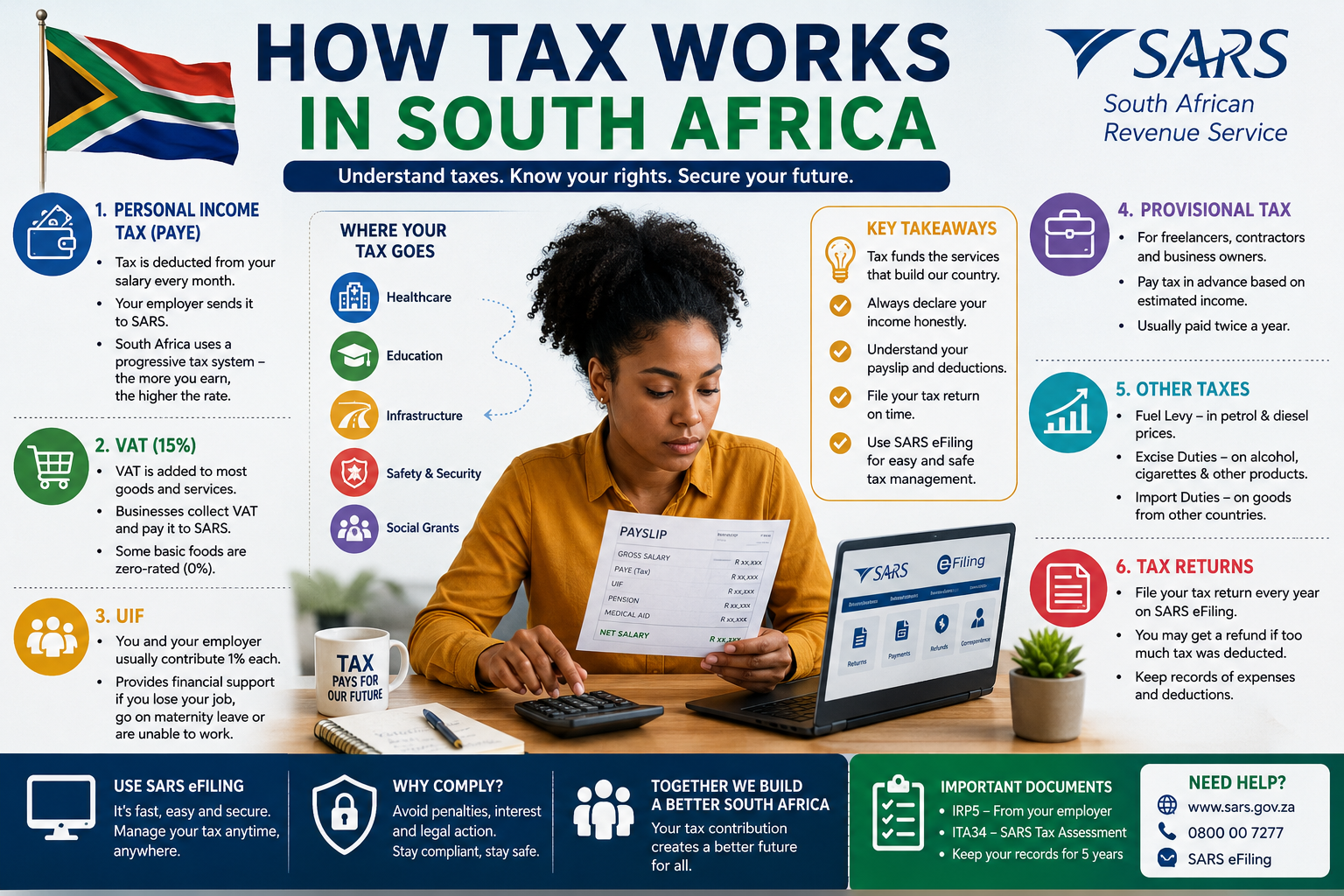
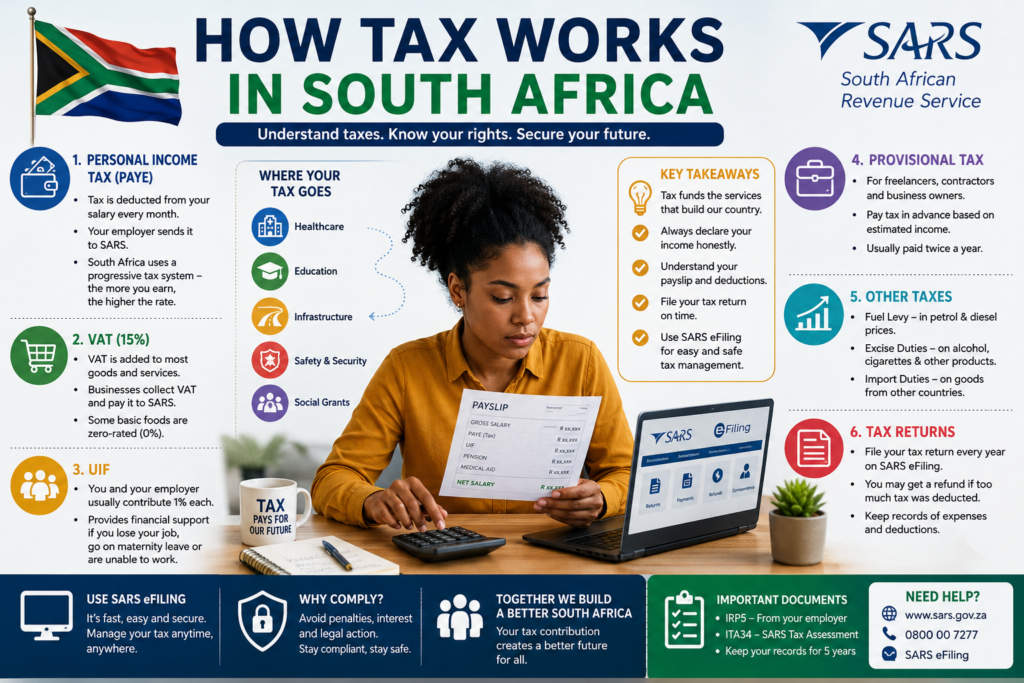
Learn how tax works in South Africa in 2026, including PAYE, VAT, UIF, SARS tax returns, tax brackets and refunds. Discover why understanding the South African tax system matters more than ever.
Tax affects nearly every financial decision South Africans make, yet many workers still do not fully understand how the system actually operates. From salary deductions and VAT on groceries to fuel levies and tax returns, taxation quietly influences household budgets, business activity and the broader economy every single day.
As living costs continue rising in South Africa, understanding the South African tax system has become increasingly important for employees, freelancers, entrepreneurs and even students entering the workforce. Many South Africans notice deductions on their payslips every month without fully understanding where the money goes, why certain taxes exist or how the South African Revenue Service (SARS) calculates what people owe.
The issue has become even more significant as SARS expands its digital verification systems, financial monitoring capabilities and automated compliance processes. Tax is no longer something affecting only accountants and large corporations. It now directly shapes financial planning, savings, side hustles, investments and long-term household stability.
This guide explains how tax works in South Africa, why the system exists, how different taxes affect ordinary citizens and what current economic trends reveal about the future of taxation in the country.
ALSO READ Are Learnerships Worth It in 2026? The Real Pros, Cons and Career Impact in SA
ALSO APPLY FOR Coega Internship Programme Intake 2026 Opens 24-Month Graduate Development Opportunities in High-Demand Fields
Quick Facts About How Tax Works in South Africa
| Tax Information | Details |
|---|---|
| Tax Authority | South African Revenue Service (SARS) |
| Country | South Africa |
| VAT Rate | 15% |
| Income Tax System | Progressive tax system |
| UIF Contribution | Usually 1% employee + 1% employer |
| Tax Season | Annual SARS filing period |
| eFiling Platform | SARS eFiling |
| Closing Date | Not stated in the official advert |
| Duration | Not stated in the official advert |
| Positions Available | Not stated in the official advert |
| Reference Number | Not stated in the official advert |
| Stipend | Not stated in the official advert |
| Required Gender | Not stated in the official advert |
| Name of the Company | Not stated in the official advert |
Why Understanding Tax in South Africa Matters More Than Ever-How Tax Works in South Africa
The South African economy has experienced increasing financial pressure in recent years due to inflation, unemployment, electricity challenges and rising living costs. As a result, taxation has become a growing concern for both households and businesses.
Most working South Africans encounter tax long before they fully understand it. Employees receive salaries with PAYE deductions already removed, consumers pay VAT on everyday purchases and motorists contribute through fuel levies without necessarily recognising how these systems connect.
At the same time, SARS has become significantly more sophisticated technologically. Modern tax administration now relies heavily on: How Tax Works in South Africa
- Banking data analysis
- Employer submissions
- Digital income tracking
- Third-party financial verification
- Automated compliance systems
This shift means tax compliance is increasingly difficult to avoid. Informal side income, freelance work and digital business activity are becoming easier for authorities to monitor.
The result is a growing need for financial literacy. South Africans who understand how taxes work are often better positioned to: How Tax Works in South Africa
- Budget effectively
- Avoid penalties
- Understand salary deductions
- Plan investments
- Manage refunds
- Build financial stability
In many ways, taxation now influences personal finance more directly than most people realise.
How PAYE Works And Why Salary Deductions Confuse Many Workers
One of the most common taxes in South Africa is PAYE, which stands for Pay-As-You-Earn.
For formally employed workers, employers deduct tax directly from salaries before employees receive payment. The employer then submits the deducted amount to SARS on behalf of the employee.
This system simplifies tax collection for government because workers do not need to calculate monthly tax themselves.
However, many employees misunderstand how these deductions are calculated.
South Africa uses a progressive tax system, meaning tax rates increase as income rises. Importantly, workers are not taxed at one flat percentage on their entire salary. Instead, different portions of income fall into different tax brackets.
For example:
- Lower income portions are taxed at lower rates
- Higher portions are taxed at higher rates
This distinction matters because many people incorrectly assume receiving a salary increase automatically causes all income to be taxed at the higher rate.
The system is designed to create greater contribution from higher earners while reducing pressure on lower-income workers.
Employees also notice additional deductions such as:
- UIF contributions
- Pension fund deductions
- Medical aid contributions
This often creates frustration when take-home pay appears significantly lower than gross salary figures advertised in employment contracts.
As economic pressure increases, understanding payslip deductions is becoming increasingly important for household budgeting and debt management.
VAT: The Tax Most South Africans Pay Every Day
While income tax mainly affects employed individuals and businesses, VAT impacts almost everyone.
VAT, or Value-Added Tax, is added to goods and services purchased by consumers. South Africa’s VAT rate currently stands at 15%.
This means consumers indirectly contribute tax every time they purchase:
- Clothing
- Electronics
- Restaurant meals
- Household products
- Many professional services
VAT plays a major role in government revenue collection because it spreads taxation across the wider economy rather than relying only on salaried workers.
However, VAT is often criticised because it affects lower-income households more heavily in practical terms. A wealthy consumer and a low-income consumer both pay VAT on many essential purchases, even though the financial impact differs significantly.
To reduce pressure on vulnerable households, government applies zero-rated VAT to certain basic food items, including:
- Brown bread
- Maize meal
- Rice
- Some vegetables
Even so, rising VAT-related costs continue influencing inflation and consumer spending patterns.
Fuel prices also contain taxes through levies and duties, which indirectly affect transportation costs, food pricing and retail expenses across the economy.
This is why tax policy often becomes closely connected to public debates around inflation, affordability and economic inequality.
Why SARS Tax Returns And Refunds Matter
Many South Africans assume that because PAYE is deducted automatically, they do not need to engage with SARS further. However, annual tax returns remain an important part of the system.
Tax returns allow SARS to verify:
- Total annual income
- Tax already paid
- Additional taxable income
- Eligible deductions
- Potential refunds
During tax season, employers issue IRP5 certificates showing employee earnings and PAYE deductions for the year.
SARS then uses submitted information to calculate whether:
- The taxpayer owes additional money
- SARS owes the taxpayer a refund
Tax refunds occur when too much PAYE was deducted or when allowable deductions reduce taxable income.
Common deductions may include:
- Retirement annuity contributions
- Medical aid tax credits
- Approved donations
- Certain travel expenses
The increasing digitisation of SARS systems has made filing faster through platforms such as:
SARS eFiling
eFiling now allows taxpayers to:
- Submit returns online
- Upload supporting documents
- Track assessments
- Monitor refunds
- Communicate digitally with SARS
This digital transformation reflects broader global trends where tax authorities rely heavily on automation and integrated financial databases.
The Rise Of Provisional Tax And The Gig Economy
South Africa’s workforce is changing rapidly.
More people now earn income through:
- Freelancing
- Online businesses
- Consulting
- Side hustles
- Digital services
- Informal entrepreneurship
Many of these workers do not have employers deducting PAYE automatically. Instead, they may fall under provisional tax systems.
Provisional taxpayers estimate their income and pay tax in advance during the financial year, usually twice annually.
This system becomes increasingly important as traditional permanent employment declines and flexible income models expand.
The challenge is that many freelancers and informal earners fail to realise their side income may still be taxable.
SARS has increasingly focused on identifying undeclared income streams through:
- Banking activity monitoring
- Platform reporting systems
- Financial data analysis
As the digital economy expands, tax authorities globally are becoming more aggressive in tracking alternative income sources.
For South Africans participating in side hustles or online income generation, understanding provisional tax obligations may become increasingly necessary to avoid penalties later.
Why Tax Compliance Has Become More Serious In 2026-How Tax Works in South Africa
Tax compliance in South Africa has changed significantly over the past decade.
Historically, some taxpayers avoided filing returns or underreported earnings with relatively low detection risk. Today, SARS operates in a far more data-driven environment.
The agency increasingly uses: How Tax Works in South Africa
- Artificial intelligence systems
- Employer reporting databases
- Banking integrations
- Third-party financial records
- Automated verification tools
This has strengthened SARS’s ability to identify: How Tax Works in South Africa
- Undeclared income
- Incorrect deductions
- Outstanding tax debt
- Non-compliance patterns
Consequences for non-compliance may include: How Tax Works in South Africa
- Penalties
- Interest charges
- Garnishee orders
- Legal action
- Frozen accounts in serious cases
This stronger enforcement environment reflects government pressure to improve tax collection amid economic strain and public spending demands.
For ordinary taxpayers, the message is becoming increasingly clear: tax administration is becoming more automated, more interconnected and far harder to ignore.
What This Means Going Forward-How Tax Works in South Africa
The future of taxation in South Africa is likely to become more digital, more integrated and more data-driven.
Several important trends are already visible:
Greater Digital Monitoring-How Tax Works in South Africa
SARS is expected to continue expanding automated financial verification systems using real-time banking and employer data.
More Attention On Side Income-How Tax Works in South Africa
Freelance work, creator income and informal digital business activity will likely face increasing tax scrutiny.
Rising Pressure On Consumers-How Tax Works in South Africa
VAT, fuel levies and inflation-linked taxes may continue affecting household affordability as government seeks sustainable revenue sources.
Stronger Financial Literacy Demands-How Tax Works in South Africa
Understanding taxation will become increasingly necessary for: How Tax Works in South Africa
- Employees
- Entrepreneurs
- Students
- Investors
- Freelancers
Increased Importance Of Tax Planning-How Tax Works in South Africa
Retirement planning, investment structuring and deduction management may become more important as economic conditions remain uncertain.
Ultimately, tax is no longer simply an administrative issue handled once a year during filing season. It now directly shapes personal finance, economic opportunity and long-term financial security for millions of South Africans.
People who understand how tax works are often better positioned to make informed financial decisions and avoid unnecessary compliance risks.
FAQs About How Tax Works in South Africa
Do all South Africans pay income tax?
No. People earning below the SARS tax threshold may not owe personal income tax. However, many still pay indirect taxes such as VAT when purchasing goods and services.
Can SARS track side hustle or freelance income?
Increasingly, yes. SARS now uses banking records, employer data and digital verification systems to identify undeclared income and compliance risks.
Conclusion-How Tax Works in South Africa
Understanding how tax works in South Africa has become increasingly important in an economy shaped by rising living costs, digital financial systems and stricter compliance monitoring.
From PAYE salary deductions and VAT to provisional tax and SARS eFiling, taxation now influences nearly every aspect of financial life. While many South Africans encounter tax daily, relatively few fully understand how the system operates or how different taxes affect household finances and long-term planning.
As SARS continues modernising its systems and expanding digital oversight, financial literacy around taxation may become one of the most important practical skills for employees, entrepreneurs and freelancers alike.
For individuals trying to manage budgets, avoid penalties and build financial stability, understanding the South African tax system is no longer optional knowledge — it is increasingly becoming an essential part of modern economic survival.




Leave a Reply